


For commercial upholstery, the Association for Contract Textiles (ACT) sets the baseline floor at 30,000 Wyzenbeek double rubs (tested to ASTM D4157 with #10 cotton duck) or 40,000 Martindale cycles (tested to ISO 12947-2 or ASTM D4966 at 12 kPa pressure) for high-traffic public spaces such as hotel lobbies, restaurants, and lounges. Private guestrooms and low-traffic offices drop to 15,000 Wyzenbeek double rubs or 20,000 Martindale cycles.
Those two numbers are only the starting line. A supplier spec sheet boasting 100,000 rubs still leads to rejected shipments or early reupholstery claims if the lab ran Martindale at the 9 kPa apparel load instead of 12 kPa, swapped cotton duck for a wire screen, skipped seam-slippage testing, missed California AB 1817 PFAS limits dropping to 50 ppm on January 1, 2027, or quoted cover fabric alone for a UK BS 5852 Crib 5 hospitality order that legally requires a fabric-plus-CMHR-foam composite certificate.
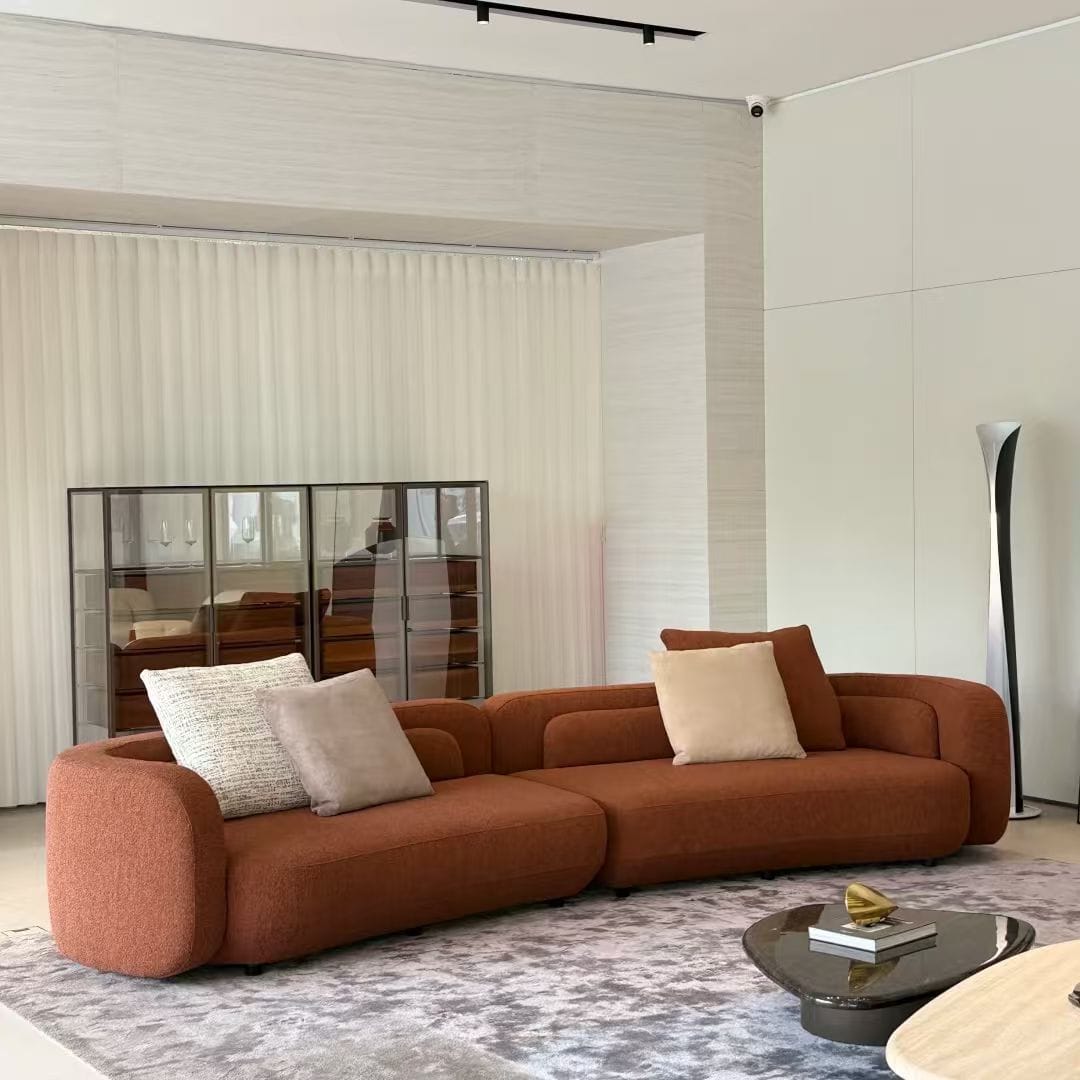
This guide gives hospitality buyers, interior specifiers, and furniture importers one unified reference for abrasion testing, real performance fabric constructions, U.S. and European flammability codes, and purchase-order verification. If you are still deciding between hide and woven textiles at the concept stage, start with our overview of leather vs fabric sofa tradeoffs, then return here to lock lab parameters into your RFQ.
Martindale Test vs. Wyzenbeek: Mechanics, Load Traps, and Why Conversion Tables Mislead
Buyers comparing textile mills in Europe, Asia, and North America routinely receive Martindale numbers from one vendor and Wyzenbeek numbers from another. Many retail blogs publish neat conversion multipliers (for example, multiplying Wyzenbeek by 1.33 to estimate Martindale). ACT explicitly warns that no valid mathematical conversion exists between the two methods. The machines apply different motion paths, different abradants, and different failure geometry.
How the Martindale Abrasion Test Works (ISO 12947-2 / ASTM D4966)
Under ISO 12947-2 and ASTM D4966-22, a circular 38 mm test specimen (backed by standard foam inside the upper specimen holder) rubs face-down against a 140 mm sheet of standard worsted wool abradant clamped to the lower table. The upper holder traces a repeating figure-eight Lissajous curve so warp, weft, and diagonal fibers experience multidirectional friction simultaneously.
For woven upholstery, the test stops at specimen breakdown, defined as two completely broken separate threads (or full pile loss down to the backing on pile fabrics like velvet and chenille). Results are typically inspected at 5,000-cycle intervals.
The biggest audit trap on Martindale reports is the applied load:
- 12 kPa (795 +/- 7 g total holder-plus-weight mass): The mandatory loading for upholstery, workwear, and heavy interior textiles under ISO 12947-2.
- 9 kPa (595 +/- 7 g total mass): Reserved for apparel and light household textiles.
When an unvetted mill tests sofa fabric at 9 kPa instead of 12 kPa, the cycle count jumps substantially without any improvement in actual wear resistance. Always verify 12 kPa on the third-party lab header before accepting a Martindale figure.
How the Wyzenbeek Test Works (ASTM D4157)
Under ASTM D4157-13(2017), strip specimens cut in the warp and weft directions are tensioned over an oscillating drum and rubbed back and forth in a straight line. Each full forward-and-return stroke counts as a single double rub (often abbreviated DR on North American swatch cards). Testing stops at two yarn breaks or appreciable surface wear.
The critical audit trap on Wyzenbeek reports is the abradant material:
- #10 Cotton Duck (ACT standard for woven upholstery): Required for ACT General Contract (15,000 DR) and Heavy Duty (30,000 DR) woven textiles.
- Wire Mesh Screen: A metal screen abradant used primarily for coated vinyls and certain synthetic substrates. It interacts completely differently with spun yarns and coated skins than cotton duck does. Comparing a cotton-duck score against a wire-screen score on two competing quotes is invalid.
| Specification Parameter | Wyzenbeek (North America) | Martindale (UK / EU / Global) | What to Check on the Lab Report |
|---|---|---|---|
| Governing Standard | ASTM D4157 | ISO 12947-2 / ASTM D4966 | Confirm exact standard code and edition year |
| Rubbing Motion | Straight linear back-and-forth (warp and weft tested separately) | Multidirectional figure-eight Lissajous pattern | Match test method to target project jurisdiction |
| Standard Abradant | #10 cotton duck (woven); wire screen (coated options) | Standard worsted wool cloth (140 mm lower table) | Reject woven reports substituting wire screen without disclosure |
| Applied Pressure / Load | Standard tensioned cylinder load per ASTM D4157 | 12 kPa (795 +/- 7 g) for upholstery | Reject 9 kPa (595 +/- 7 g) apparel load on sofa fabrics |
| Failure Endpoint (Woven) | 2 broken yarns or appreciable surface wear | 2 completely broken separate threads (or full pile loss) | Check whether rating stopped at breakdown or arbitrary cap |
| ACT Low-Traffic / Private Floor | 15,000 double rubs | 20,000 cycles | Guestrooms, executive offices, occasional seating |
| ACT High-Traffic / Public Floor | 30,000 double rubs | 40,000 cycles | Hotel lobbies, dining banquettes, public lounges |
| Heavy-Duty Coated / Vinyl Floor | 50,000 double rubs (ACT coated guideline) | Project-specified (commonly 50,000 to 100,000+) | Also require hydrolysis (jungle test) on PU faux leather |
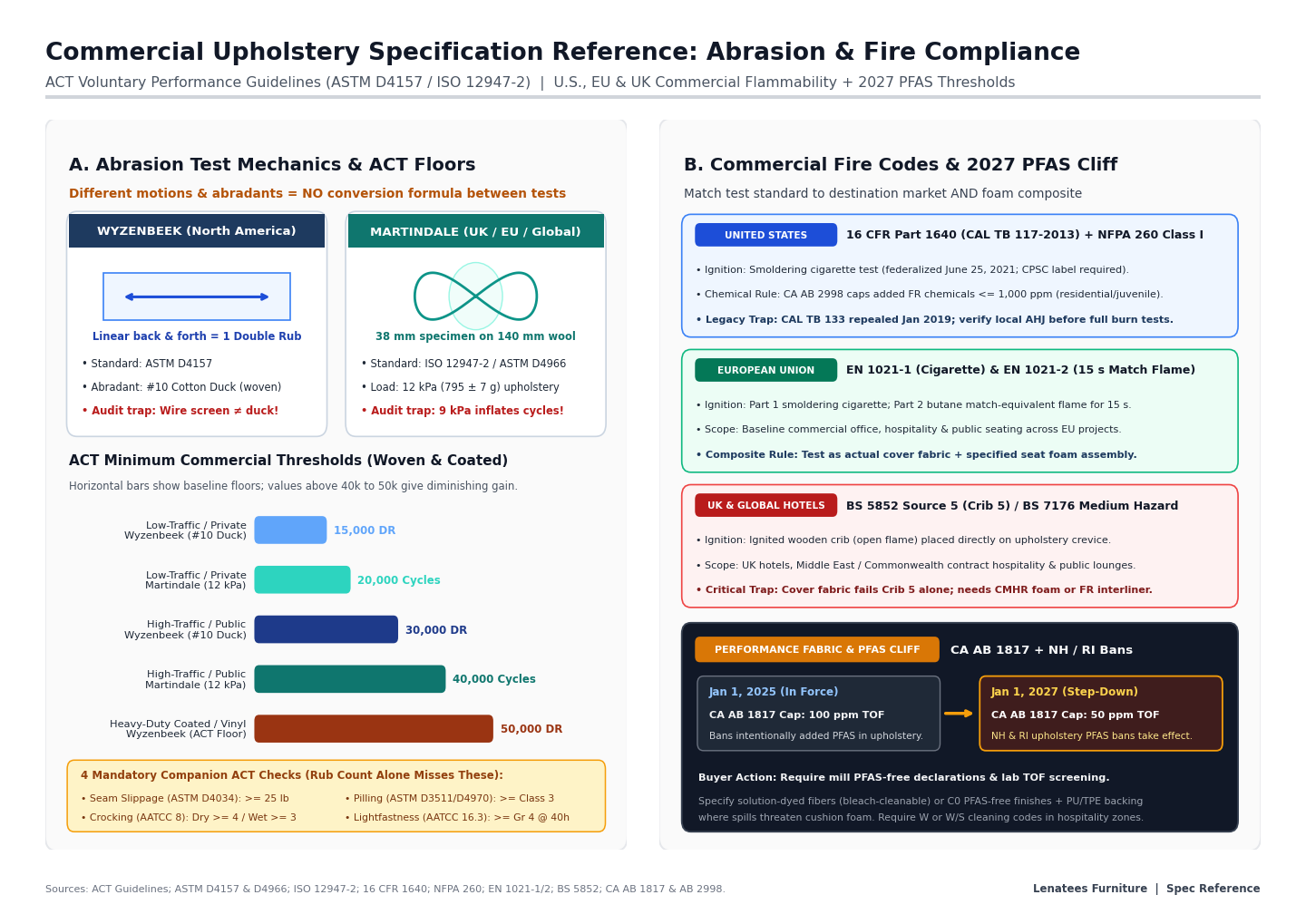
Rub Count Fabric Thresholds by Room Type (And Why 100,000 Rubs Rarely Extends Sofa Life)
Over-specifying abrasion is one of the most expensive habits in hospitality purchasing. Many RFQs demand 100,000 double rubs for every chair in a hotel, which eliminates soft residential-feeling boucles, wool blends, and tailored linens while adding zero practical lifespan to a guestroom accent chair.
In its published Voluntary Performance Guidelines, ACT notes that lab abrasion measures only flat surface rubbing. Once a woven textile clears 30,000 double rubs on Wyzenbeek or 40,000 cycles on Martindale, real-world contract seating almost never fails because the flat seat deck wore through. Instead, upholstery fails first from seam slippage, pilling, dye transfer (crocking), UV fading, housekeeping chemical damage, or poor underlying cushion support.
| Application Zone | Wyzenbeek Minimum (#10 Cotton Duck) | Martindale Minimum (12 kPa Load) | Mandatory Companion Checks Beyond Rub Count |
|---|---|---|---|
| Decorative Pillows & Throws | 9,000 to 12,000 DR | 10,000 to 15,000 cycles | Crocking check on dark accent cushions against pale sofas |
| Private Hotel Guestroom / Executive Office | 15,000 DR (ACT Low Traffic) | 20,000 cycles (ACT Low Traffic) | Seam slippage >= 25 lb; Cleaning code W or W/S |
| Daily Family Living Room / Villa Sofa | 25,000 to 30,000 DR | 30,000 to 40,000 cycles | Pilling >= Class 3; tight weave if pets are present |
| Hotel Lobby, Restaurant & Public Lounge | 30,000 DR (ACT High Traffic) | 40,000 cycles (ACT High Traffic) | Full ACT woven suite + moisture barrier if food/drinks served |
| Coated Vinyl / Faux Leather Contract Seating | 50,000 DR (ACT Heavy Coated) | 50,000 to 100,000+ cycles | Hydrolysis resistance (wet heat peeling) + cold crack rating |
| 24/7 Healthcare, Airport & Casino Seating | 50,000 to 100,000 DR | 60,000 to 100,000+ cycles | Bleach-cleanable solution-dyed yarn or medical-grade coated vinyl |
The Four ACT Companion Metrics Every Spec Sheet Must Include
Ask your fabric mill or furniture factory for these four numbers alongside rub count:
- Seam Slippage (ASTM D4034): Minimum 25 lb (111 N) in both warp and weft. Loose decorative weaves and chunky boucles can survive 50,000 flat rubs yet rip open along seat-edge piping within 90 days if seam slippage falls below 25 lb. Backing the fabric with acrylic latex or knit tricot fixes marginal slippage, but must be priced and tested before bulk cutting.
- Pilling Resistance (ASTM D3511 brush pill or ASTM D4970 Martindale): Minimum Class 3 (on a 1 to 5 scale). Soft staple-spun polyester and wool blends often form fuzzy surface pills long before a single thread breaks.
- Colorfastness to Crocking (AATCC 8): Dry Grade 4 minimum, Wet Grade 3 minimum (1 to 5 scale). Piece-dyed dark navies, forest greens, and terracottas frequently bleed onto guest jeans or damp towels when wet crocking drops to Grade 2.
- Colorfastness to Light (AATCC 16.3, Option 1 or 3): Minimum Grade 4 at 40 hours. Lobby sofas parked beside floor-to-ceiling atrium glazing fade in under one season regardless of rub count if UV lightfastness is unverified.
Construction underneath the cover matters just as much. When low-density cushion foam collapses or sharp plywood deck edges lack thick Dacron wrap, every seated load concentrates along a single crease line. Review our sofa foam density specification guide to pair proper cushion density with your upholstery grade, and if your program ships vacuum-packed seating, cross-check textile recovery in our compression sofa foam testing and fabric recovery guide.
What Is Performance Fabric? Three Constructions and the 2027 PFAS Compliance Cliff
“Performance fabric” is a commercial marketing label, not a single laboratory standard. Two swatches both marketed as stain-resistant performance fabric can behave completely differently after six months of hotel housekeeping, and one of them may now violate U.S. state chemical bans.
Before paying a 25% to 60% upcharge for performance upholstery, confirm which of three engineering mechanisms is doing the work:
- Inherently Stain-Resistant Solution-Dyed Fibers (Acrylic, Polypropylene/Olefin, Solution-Dyed Polyester): Pigment is mixed into the liquid polymer before the yarn is extruded. Color runs all the way through the fiber core, leaving almost no dye sites for red wine, coffee, or ink to bond. Most solution-dyed contract fabrics tolerate diluted household bleach cleaning (typically 1 part bleach to 10 parts water, rinsed thoroughly) and deliver strong UV stability without relying on chemical sprays.
- PFAS-Free Topical Stain Finishes (Hydrocarbon, Silicone, or Plant-Based C0 Chemistry): A surface treatment applied after weaving that lowers surface tension so water and coffee bead up for blotting. Unlike legacy fluorinated finishes, modern PFAS-free C0 coatings handle water-based spills well but offer weaker long-term resistance to hot cooking oils and body sebum, and they gradually wear down under aggressive solvent scrubbing.
- Laminated Moisture-Barrier Backings (PU or TPE Film): A flexible waterproof membrane bonded to the back of a woven face fabric. Liquids cannot soak down into the polyurethane cushion core, preventing permanent odor and mold in restaurant banquettes, senior living residences, and healthcare lounges. Tradeoffs include firmer drape on tight curves, warmer seating feel, and slightly lower seam breathability.
The January 1, 2027 PFAS Step-Down: Why Old Swatch Books Create Customs Risk
Historically, top-selling stain-resistant fabrics relied on short-chain or long-chain PFAS (per- and polyfluoroalkyl substances) to repel both water and oil. That regulatory window has closed in major U.S. states:
- California AB 1817 (Safer Clothes and Textiles Act): Explicitly defines covered “textile articles” to include residential and commercial upholstery and furnishings. Since January 1, 2025, intentionally added PFAS are banned with a Total Organic Fluorine (TOF) threshold of 100 ppm. On January 1, 2027, California halves that legal ceiling to 50 ppm TOF, and manufacturers must supply downstream buyers with a written Certificate of Compliance.
- New Hampshire and Rhode Island: Broad state sales bans on upholstered furniture and textile furnishings containing intentionally added PFAS take effect on January 1, 2027, joining earlier restrictions in Maine, Washington, Colorado, and New York textile rules.
For any container shipping to the United States in late 2026 or 2027, ask your upholstery factory to confirm in writing that the selected lot uses zero intentionally added PFAS and verify third-party TOF screening below 50 ppm if goods will enter California distribution.
Read the Cleaning Code Before Approving Any Contract Sample
A 60,000-rub fabric with the wrong cleaning code still fails hotel operations:
- W (Water-based cleaners): Safe for foam or water-based extraction. Standard baseline for commercial guestrooms and family sofas.
- W/S (Water or solvent-based): Maximum housekeeping flexibility for lobbies, dining seating, and short-term rentals.
- S (Solvent / dry-clean only): Avoid on public hospitality seating; water spotting leaves rings that housekeepers cannot remove safely.
- X (Vacuum or light brush only): Never specify for food-service, hotel, or family sofas regardless of rub count.
Commercial Upholstery Flammability Codes: CAL 117, NFPA 260, EN 1021, and BS 5852 Crib 5
Flammability rules vary sharply by destination country, and outdated copy-pasted hotel tenders regularly waste thousands of dollars on repealed tests or illegal chemical additives. Match your specification to the actual building jurisdiction:
United States: 16 CFR Part 1640, NFPA 260, AB 2998, and the Repealed CAL TB 133
- 16 CFR Part 1640 (Federalized CAL TB 117-2013): Effective June 25, 2021, Congress and the U.S. Consumer Product Safety Commission adopted California Technical Bulletin 117-2013 under 16 CFR Part 1640 as the mandatory national flammability standard for residential upholstered furniture (administered originally in California by the Bureau of Household Goods and Services). It evaluates smoldering cigarette ignition on cover fabrics, barriers, resilient filling materials, and decking rather than open flame. Compliant pieces must carry a permanent label stating: “Complies with U.S. CPSC requirements for upholstered furniture flammability.”
- NFPA 260 Class I (and ASTM E1353): The U.S. contract and hospitality smolder benchmark adopted by ACT. Under NFPA 260, Class I confirms cigarette-ignition resistance for cover fabrics on commercial furniture.
- California AB 2998 (Flame-Retardant Chemical Ban): Effective January 1, 2020, California prohibits covered chemical flame retardants above 1,000 ppm in new residential upholstered furniture, juvenile products, and mattresses. Because TB 117-2013 and 16 CFR Part 1640 test smoldering resistance rather than open flame, compliant fabrics and foams should pass without adding banned chemical flame retardants.
- CAL TB 133 Was Repealed in January 2019: California officially repealed full-scale open-flame burn test TB 133 effective January 1, 2019. Many legacy hospitality FF&E templates still list “CAL 133 required” out of habit. Before paying for sacrificial full-chair burn testing or heavy FR barrier cloths, ask the project architect or local Authority Having Jurisdiction (AHJ) whether the building sits in a sprinkler-exempt occupancy or a city with its own open-flame mandate (such as Boston Fire Department BFD IX-1).
Europe and United Kingdom: EN 1021-1/2 and BS 5852 Crib 5 Composites
- EN 1021-1 & EN 1021-2 (EU Commercial Baseline): Part 1 tests smoldering cigarette ignition; Part 2 applies a butane match-equivalent open flame for 15 seconds to the crevice of the upholstery assembly. Both evaluate the composite of cover fabric plus actual seat filling.
- BS 5852 Source 5 (Crib 5) / BS 7176 Medium Hazard (UK, Middle East, and International Five-Star Hotels): Places a small ignited wooden crib directly onto the furniture mock-up crevice, creating a much higher thermal load than a cigarette or match.
Here is the single biggest procurement mistake on UK and Middle East hotel orders: a fabric alone cannot pass BS 5852 Crib 5 over standard polyurethane foam. Crib 5 is a composite system performance test. Either the fabric must be paired with certified CMHR (Combustion Modified High Resilience) foam matching the lab report density, or an approved fire-retardant interliner/barrier cloth must sit between the decorative cover and the cushion core.
| Destination Market | Governing Standard | Primary Ignition Source | Composite Foam Requirement | Key Chemical / Labeling Rule |
|---|---|---|---|---|
| U.S. Residential / General | 16 CFR Part 1640 (CAL TB 117-2013) | Smoldering cigarette | Component mock-up (cover, barrier, foam, decking) | Permanent CPSC label required; CA AB 2998 caps added FR <= 1,000 ppm |
| U.S. Commercial / Hospitality | NFPA 260 Class I (ASTM E1353) | Smoldering cigarette | Tested over standard polyurethane substrate | Check local AHJ before pricing legacy CAL TB 133 (repealed Jan 2019) |
| European Union Contract | EN 1021-1 & EN 1021-2 | Cigarette (Part 1) + 15 s match flame (Part 2) | Cover fabric + actual specified foam composite | Verify REACH compliance on any FR back-coating |
| UK / Middle East / Global Contract | BS 5852 Source 5 (Crib 5) / BS 7176 | Ignited wooden crib (open flame) | Mandatory composite: cover fabric + CMHR foam or FR interliner | Never substitute standard non-FR foam after approval |
| U.S. PFAS-Regulated States | CA AB 1817, NH & RI PFAS bans | Chemical restriction (non-fire) | Applies to finished upholstered textile articles | CA TOF cap drops 100 ppm -> 50 ppm on Jan 1, 2027 |
Worked RFQ Comparison: Two Lobby Sofa Quotes Priced $115 Apart (Illustrative Example)
To show how missing lab details hide inside a low unit price, consider the following illustrative procurement comparison for 40 three-seat lobby sofas destined for a boutique hotel operating across U.S. and UK hospitality standards. The figures below are an educational quote-audit model, not a published laboratory test report for a specific Lenatees SKU.
| Audit Line Item | Quote A ($680 / Sofa) | Quote B ($795 / Sofa) | Procurement Risk & Downstream Cost |
|---|---|---|---|
| Abrasion Rating Claimed | “100,000 rubs” (method and abradant omitted; mill report turns out to be 9 kPa Martindale) | 45,000 Wyzenbeek DR (#10 cotton duck) & 50,000 Martindale (12 kPa / 795 g) | Quote A’s inflated 9 kPa score cannot be verified against ACT High-Traffic rules |
| Seam Slippage (ASTM D4034) | Not tested | 32 lb warp / 29 lb weft (knit-backed weave) | Unbacked loose weaves under 25 lb tear along seat piping within months |
| Pilling & Crocking | Not listed | Pilling Class 4; Crocking Dry 4.5 / Wet 4 | Avoids premature fuzzing and dye transfer on light guest clothing |
| Stain Protection & PFAS | “Waterproof spray” (unverified legacy fluorocarbon) | Solution-dyed polyester + C0 PFAS-free finish; mill declaration + TOF < 50 ppm | Quote A risks California AB 1817 rejection after Jan 1, 2027 |
| Cleaning Code | Code S (solvent only) | Code W/S (water or solvent extraction) | Housekeeping water extraction leaves permanent rings on Code S covers |
| Flammability Composite | Fabric-only “FR treated” slip; standard 32 kg/m3 foam | 16 CFR 1640 + NFPA 260 Class I (U.S.) or BS 5852 Crib 5 over CMHR foam (UK) | Quote A fails UK/Middle East fire inspection on site, triggering full reupholstery |
Paying $115 less per sofa saves $4,600 upfront on a 40-sofa order. Reupholstering just ten lobby sofas on site in the U.S. or UK after early seam failure or failed fire-marshal inspection routinely exceeds $12,000 to $18,000 in labor, replacement yardage, and lost room revenue.
Seven Checks to Lock Into Your Upholstery Purchase Order
Whether you are sourcing through a custom sofa manufacturer in China or assembling a full hotel room furniture tender, paste these seven verifiable requirements directly into your fabric schedule and PO:
- Name the exact test standard and loading: Write
ASTM D4157 (#10 cotton duck, >= 30,000 DR)for North American public seating orISO 12947-2 (12 kPa / 795 g load, >= 40,000 cycles)for UK/EU contract projects. Never accept a bare number. - Require the four ACT companion rows: Lock minimum thresholds for seam slippage (
ASTM D4034 >= 25 lb), pilling (ASTM D3511/D4970 >= Class 3), crocking (AATCC 8 Dry >= 4 / Wet >= 3), and lightfastness (AATCC 16.3 >= Grade 4 at 40 h). - Define the performance mechanism and cleaning code: Specify whether you require solution-dyed yarn, a PFAS-free topical finish, or a laminated PU/TPE moisture barrier, paired with
WorW/Scleaning codes for hospitality rooms. - Demand written PFAS-free declarations for 2027 shipments: For U.S. orders entering California, New Hampshire, Rhode Island, or national retail distribution, require a mill Certificate of Compliance confirming no intentionally added PFAS and TOF testing below 50 ppm.
- Specify flammability by jurisdiction AND composite foam: State
16 CFR Part 1640 + NFPA 260 Class I(with CA AB 2998 <= 1,000 ppm FR chemical limit where applicable) for U.S. orders,EN 1021-1/2for EU contract, orBS 5852 Crib 5 over CMHR foamfor UK/Middle East public spaces. - Sign off a physical cutting-lot swatch (CFC) before mass cutting: Dye-lot shade shifts, backing stiffness, and pile direction cannot be evaluated from a PDF. Approve a physical production-lot sample alongside your hotel room furniture specification checklist.
- Tie final balance payment to pre-shipment QC inspection: Verify CPSC or UK fire labels, seam stitch density, color lot consistency, and matching third-party lab certificate numbers under a documented factory quality control inspection before container loading.
If you have an active upholstery schedule for hospitality lounges, guestrooms, or commercial seating collections, review our living room sofa catalog or send your room schedule to our hotel furniture manufacturing team for sample swatch books, foam composite matching, and third-party lab test coordination.
Frequently Asked Questions
Can you convert a Wyzenbeek double rub score into a Martindale cycle count?
No. ACT states directly that there is no reliable mathematical conversion between Wyzenbeek (ASTM D4157) and Martindale (ISO 12947-2 / ASTM D4966). Linear cotton-duck abrasion and multidirectional wool-abradant abrasion stress yarns differently, so a fabric that scores high on one machine can underperform on the other. Always request test results in the standard required by your project’s country.
What Martindale rub count is enough for a commercial hotel sofa?
For high-traffic public areas such as hotel lobbies, bars, and dining lounges, ACT sets 40,000 Martindale cycles at the 12 kPa (795 g) upholstery load as the commercial minimum. For lower-traffic private hotel guestrooms or executive offices, 20,000 Martindale cycles at 12 kPa meets the ACT general contract baseline. Always verify seam slippage, pilling, and cleaning code alongside the rub count.
What actually makes a fabric a “performance fabric”?
True performance comes from one or more of three constructions: inherently stain-resistant solution-dyed fibers (acrylic, olefin, or solution-dyed polyester), PFAS-free topical stain-repellent finishes, or laminated PU/TPE moisture-barrier backings that stop liquids from entering cushion foam. Because California AB 1817 lowers the Total Organic Fluorine limit to 50 ppm on January 1, 2027, confirm PFAS-free certification before approving any stain-resistant finish for U.S. orders.
Do U.S. commercial hotel sofas still need CAL TB 133 testing?
In most jurisdictions, no. California repealed Technical Bulletin 133 effective January 1, 2019. Today, U.S. residential and general upholstered furniture follows federal 16 CFR Part 1640 (CAL TB 117-2013 smolder testing), while U.S. commercial interiors typically specify NFPA 260 Class I. Only budget for full-scale open-flame burn testing if your project sits in an unsprinklered high-risk occupancy or a local fire jurisdiction (such as Boston BFD IX-1) that explicitly enforces it.
Why can a fabric pass CAL 117 in the U.S. yet fail BS 5852 Crib 5 in the UK?
CAL TB 117-2013 (16 CFR Part 1640) evaluates resistance to a smoldering cigarette, which tightly woven fabrics can pass over standard polyurethane foam without chemical flame retardants. BS 5852 Source 5 (Crib 5) places an ignited open-flame wooden crib onto the full upholstery assembly, requiring either certified CMHR (Combustion Modified High Resilience) foam or an approved FR interliner beneath the cover fabric to self-extinguish.
Sources and Scope Limits
- Association for Contract Textiles (ACT): ACT Voluntary Performance Guidelines (Low Traffic / High Traffic woven and heavy-duty coated abrasion floors, seam slippage ASTM D4034, pilling ASTM D3511 / D4970, crocking AATCC 8, lightfastness AATCC 16.3, and guidance against Wyzenbeek-to-Martindale conversion).
- ASTM International: ASTM D4157-13(2017) (Oscillatory Cylinder / Wyzenbeek Method) and ASTM D4966-22 (Martindale Abrasion Tester Method).
- ISO (International Organization for Standardization): ISO 12947-2 (Martindale determination of specimen breakdown: 38 mm specimen, 140 mm worsted wool abradant, 12 kPa / 795 +/- 7 g upholstery load vs 9 kPa / 595 +/- 7 g apparel load).
- U.S. Consumer Product Safety Commission & California BHGS: 16 CFR Part 1640 (eCFR) (federal adoption of CAL TB 117-2013 effective June 25, 2021) and California Bureau of Household Goods and Services (TB 117-2013 administration, January 2019 repeal of TB 133, and AB 2998 1,000 ppm flame-retardant chemical cap).
- National Fire Protection Association: NFPA 260 (Standard Methods of Tests and Classification System for Cigarette Ignition Resistance of Components of Upholstered Furniture).
- European & UK Fire Standards: EN 1021-1 (smoldering cigarette), EN 1021-2 (15-second match-flame equivalent), BS 5852 Source 5 (Crib 5), and BS 7176 (Medium Hazard contract seating composites).
- U.S. State PFAS Textile Legislation: California AB 1817 (100 ppm TOF effective January 1, 2025; 50 ppm TOF effective January 1, 2027) and New Hampshire / Rhode Island upholstered furniture PFAS bans effective January 1, 2027.
Scope Note: This reference explains laboratory test methods, regulatory thresholds, and procurement checks. Illustrative quote comparisons and standard ranges are educational specification tools and do not constitute a product-specific compliance certificate. Always confirm lot-specific third-party laboratory test reports matched to your exact cover fabric, backing, and foam composite before final project sign-off.