





Before placing a container order for a vacuum-packed compression sofa, verify three numbers on signed paperwork: the foam compression-set formula (Ct versus Cd) on the laboratory report, the maximum sealed storage window before decompression slows or fails, and the integer-grid carton count inside an ISO 668 40ft High Cube (40HQ) container. Marketing phrases such as “high-density rebound sponge” or “75% space saving” cannot qualify a shipment for retail distribution, serviced apartments, or hospitality procurement.
A compressed sofa in a box removes the rigid timber or steel frame used in conventional upholstered seating and relies on monolithic or laminated open-cell polyurethane foam (or a hybrid seat core pairing pocket springs with foam layers) to carry structural loads. Removing the frame shrinks shipping volume and clears narrow elevators or stairwells, yet it shifts every structural, visual, and freight-cost risk onto the foam formulation, the spring cassette (if hybrid), the upholstery textile, the vacuum barrier film, and the outer export carton geometry.
Where a compression sofa fits B2B procurement and where it fails
Frameless vacuum-packed sofas perform well when freight cube, tight building access, or small-parcel delivery ceilings drive landed cost. They create warranty exposure when specified for heavy-traffic commercial lobbies or projects expecting crisp, rigid architectural tailoring straight out of the bag.
| Procurement scenario | Fit for vacuum-packed frameless sofa | Primary failure mode to manage | Alternative when risk is too high |
|---|---|---|---|
| Direct-to-consumer e-commerce and boxed retail | High fit when packed cartons stay below regional parcel oversize cliffs (130 in L+G) and 150 lb hard limits | Returns during the first 24 to 72 hours over corner creases, slow loft recovery, or trapped foam odor | Modular knock-down framed sofa shipped flat-packed |
| Multi-family apartments, student housing, and tight urban walk-ups | High fit where narrow corridors or small lifts block rigid 220 cm frames | Long warehouse dwell times before unit turnover causing permanent compression set | Knock-down steel or solid-wood framed modular seating |
| Boutique hospitality lounges and short-stay serviced suites | Conditional fit; require dynamic fatigue reports and jurisdiction-specific commercial fire documentation | Edge roll-off on seat fronts, loose backrest slump, and visible fabric puckering | Commercial contract-framed sofa with replaceable cushion cores |
| High-turnover hotel lobbies and formal contract reception areas | Poor fit for all-foam frameless builds | Rapid armrest distortion, low seat height (often under 40 cm), and lack of rigid base legs for floor cleaning | Kiln-dried hardwood or steel contract frame |
If you are evaluating baseline cushion foam density (kg/m³ versus lb/ft³) and multi-layer seat builds for conventional framed sofas rather than vacuum-packed monolithic blocks, review our separate sofa foam density specification guide. When comparing frameless silhouettes such as Lenatees’s LF028 compressed modular sofa reference (documented as a June 2024 historical catalog reference in corduroy upholstery across 200 to 300 cm configurations), confirm current production availability, foam specifications, expanded dimensions, and carton packing in writing before sampling.

Example of a frameless, legless corduroy modular compression sofa silhouette from Lenatees’s June 2024 LF028 historical catalog reference. Current production availability, foam grade, expanded dimensions, and carton packing require written confirmation before ordering.
Foam compression testing standards you need on the lab report
Density alone (kg/m³ or lb/ft³) measures mass per unit volume, not whether a sofa block regains its full height after sitting vacuum-sealed inside an ocean container for 45 to 90 days. Two foams with identical nominal density behave differently after sustained vacuum compression depending on polyol chemistry, cell openness, inert mineral filler content (such as calcium carbonate added to raise apparent weight), and pre-compression cure time.
Request test reports tied to named methods under ASTM D3574-25 (Standard Test Methods for Flexible Cellular Materials: Slab, Bonded, and Molded Urethane Foams) or the corresponding ISO standards:
| Property buyers must verify | ASTM D3574-25 test method | ISO equivalent | Key test conditions to check on the certificate | What a weak result looks like after unboxing |
|---|---|---|---|---|
| Apparent foam density | Test A | ISO 845 | Mass divided by dry volume; ask whether calcium carbonate or mineral fillers are present | Foam feels heavy in hand yet collapses early because inert filler replaces load-bearing polymer |
| Indentation hardness (firmness) | Test B1 (IFD at 25% and 65% deflection) | ISO 2439:2008 (primary index at 40% indentation, plus 25% and 65%) | 203 mm indenter foot (ASTM) vs 200 mm (ISO); never compare ASTM 25% IFD directly against ISO 40% hardness | Seat feels overly soft or bottoms out under adult loads despite matching a supplier label |
| Compression stress-strain | Test C (CFD at 50% deflection) | ISO 3386-1 (CV40 at 40% compression on 4th cycle) | Full-surface compression on small block specimen (50 × 50 × 25 mm in ASTM Test C) | Armrests and corner blocks sag laterally where full-width foam carries load without a rigid frame |
| Dry constant deflection compression set | Test D | ISO 1856:2018 (Method A) | 50%, 75%, or 90% deflection (ISO Method A commonly 50% or 75%) at 70 °C for 22 h; 30 to 40 min recovery (ASTM) or 30 min (ISO) | Permanent height loss, concave seat panels, and rounded corners that never regain catalog dimensions |
| Wet heat and humid aging resistance | Test L (Wet Heat Aging / Wet Compression Set) & Test J (Steam Autoclave) | ISO 2440 (humid aging) / ISO 1856 wet variants | Test L commonly exposes specimens to 50 °C and 95% RH for 22 h; Test J runs accelerated steam autoclave hydrolysis | Foam passes dry factory checks yet loses height or crumbles after humid summer sea transit |
| Surface resilience (elasticity) | Test H (Ball Rebound) | ISO 8307 | 16 mm steel ball dropped from 500 mm onto conditioned specimen | Sluggish rebound after unboxing and flat, dead seating feel |
| Dynamic fatigue durability | Test I3 (Constant Force Pounding) | ISO 3385:2014 | 750 N constant-load pounding at 70 cycles per minute (8,000 cycles Procedure A or 80,000 cycles Procedure B) on 380 × 380 × 50 mm specimen | Early softening and visible body impressions within months of occupancy |
When auditing a supplier certificate, verify the test date, specimen batch ID, laboratory accreditation, and deflection percentage. A sheet listing only apparent density (Test A) and a single 25% IFD figure (Test B1) provides zero evidence of recovery after vacuum compression or humid ocean transit.
Avoid the ASTM D3574 Test D formula trap: Ct versus Cd
One of the easiest specification errors in B2B foam sourcing happens when buyers compare compression-set percentages across two test reports without checking which denominator each laboratory used.
Under ASTM D3574 Test D, a standard 50 × 50 × 25 mm specimen is compressed to a fixed deflection (50 ± 1%, 75 ± 1%, or 90 ± 1%) inside spacer plates, held in a circulating oven at 70 ± 2 °C (158 °F) for 22 hours, released, and measured after 30 to 40 minutes of recovery at standard laboratory conditions (23 ± 2 °C, 50 ± 10% RH). ASTM D3574 allows two different equations to express the same physical thickness loss:
- Original-thickness basis (
Ct, preferred in ASTM D3574 and matching ISO 1856:2018):Ct = [(to − tf) / to] × 100 - Original-deflection basis (
Cd, also defined in ASTM D3574 Test D):Cd = [(to − tf) / (to − ts)] × 100
Here to is original specimen thickness, tf is final recovered thickness, and ts is spacer thickness during compression.
Because Cd divides permanent thickness loss by the applied deflection (to − ts) rather than full thickness to, the reported percentages split sharply whenever deflection is under 100%. Consider a hypothetical 25.0 mm foam specimen that suffers 2.5 mm of permanent thickness loss (tf = 22.5 mm):
| Compression deflection level | Spacer thickness (ts) | Deflection applied (to − ts) | Ct (loss / original thickness) | Cd (loss / applied deflection) | Ratio (Cd / Ct) |
|---|---|---|---|---|---|
| 50% deflection | 12.50 mm | 12.50 mm | 10.0% | 20.0% | 2.00× |
| 75% deflection | 6.25 mm | 18.75 mm | 10.0% | 13.3% | 1.33× |
| 90% deflection | 2.50 mm | 22.50 mm | 10.0% | 11.1% | 1.11× |
At 50% deflection, Cd is double Ct. That formula difference creates a real sourcing trap:
- Supplier A quotes “compression set ≤ 10%” using
Ctat 50% deflection, allowing up to2.50 mmof permanent thickness loss on a25.0 mmsample (equivalent toCd = 20.0%). - Supplier B quotes “compression set ≤ 12%” using
Cdat 50% deflection, which permits only0.12 × 12.50 = 1.50 mmof permanent loss (equivalent toCt = 6.0%).
A buyer scanning a quote comparison table without checking the formula would award the order to Supplier A thinking 10% beats 12%, even though Supplier B’s foam lost 40% less height. State the exact standard, the deflection percentage (50%, 75%, or 90%), and the denominator (Ct or Cd) on your purchase order. Because vacuum-packed sofas undergo roughly 70% to 85% thickness reduction during pressing and rolling, request 75% or 90% deflection Test D results plus wet heat aging (Test L) alongside standard 50% dry numbers whenever the laboratory supports them.
Decompression timeline, hybrid springs, upholstery creasing, and fire codes
Laboratory ovens run for 22 hours, whereas export cargo travels from a factory floor in Foshan through port storage, tropical ocean transit, customs clearance, and destination warehousing before an end customer cuts the vacuum bag. Real-world recovery depends on five shop-floor and compliance variables that consumer guides skip.
- Foam cure time before vacuum sealing. Freshly poured polyurethane slabstock continues chemical cross-linking and off-gassing after cutting. Pressing foam too early after foaming or adhesive lamination locks in cell collapse and seals solvent or amine odors inside the polyethylene barrier bag. Confirm minimum post-pour curing and post-gluing ventilation hours in writing.
- Hybrid pocket-spring vs all-foam compression stress. Some compression sofas embed individual pocket-spring cassettes inside foam surrounds to improve seat bounce. Tightly rolling a pocket-spring sofa into a cylinder bends outer coils unevenly and can tear lightweight spunbond non-woven spring pockets, causing permanent seat tilt or metallic noise after unboxing. For hybrid models, require wire gauge and heat-tempering specs, heavier non-woven pocket fabric weight, and confirm whether the unit ships flat-compressed rather than tightly rolled.
- Sealed shelf life, container heat, and winter unboxing. Ocean containers sitting on terminal yards or crossing equatorial lanes face high internal temperatures and condensation risk (“container rain”). Print “Pack Date” and “Open By” batch stamps on outer cartons, include container desiccants, and test one archived unit held sealed for at least 14 to 30 days rather than approving mass production from a factory video shot 24 hours after sealing. Cold winter deliveries slow air re-entry into polyurethane cells; run incoming QC acceptance checks in a conditioned room (
20 to 23 °C) at 2 hours (initial loft), 72 hours (shape and seam alignment), and 7 days (final seat height, backrest height, overall width, and diagonal squareness). - Upholstery fabric construction and seam stress. Tight vacuum folding stresses fabric backings and corner miters differently across textile families:
| Upholstery textile class | Behavior under tight vacuum compression | Buyer inspection checks after 72 hours |
|---|---|---|
| Wide-wale corduroy and brushed chenille | Deep pile and surface texture help hide light fold lines; softer drape eases corner recovery | Check wale crushing along fold axes, pile shading shifts, and seam slippage at corner miters |
| Heavy woven boucle and textured polyester | Textured yarns conceal micro-wrinkles well, though stiff latex backings can hold fold ridges | Inspect backing crack lines, corner seam puckering, and zipper or hook-and-loop alignment |
| Smooth velvet and flat-weave microfiber | Shows pressure bruising, glossy crush marks, and fold creases prominently | Test garment-steam recovery on a compressed pre-production sample held sealed for 14 to 30 days |
| Coated PU, PVC, and smooth top-grain leather | High risk of permanent fold creases, delamination, or topcoat cracking under vacuum roll-packing | Avoid tight vacuum roll-packing unless the supplier supplies documented aging-recovery proof for the exact coated substrate or hide |
- Residential vs commercial fire compliance. For indoor residential sofas imported into the United States, vacuum-packed upholstered seating falls under federal smolder-resistance requirements in 16 CFR Part 1640, which incorporates California TB 117-2013 for cover fabrics, barriers, and resilient filling materials and requires a permanent, securely affixed compliance label stating: “Complies with U.S. CPSC requirements for upholstered furniture flammability.” Verify that sewn-in law and flammability labels survive vacuum folding without tearing at the seam. For commercial and hospitality projects, note that California formally repealed full-scale open-flame TB 133 effective January 22, 2019, yet legacy hotel brand standards or specific unsprinklered public-occupancy jurisdictions still reference full-scale open-flame testing under ASTM E1537 (and UK or EU contract buyers commonly require BS 5852 or BS 7176). Confirm local code requirements before placing an all-foam frameless unit into a commercial space.
Worked example: 40HQ container loading, carton bulge, and U.S. parcel DIM weight
Export quotes frequently estimate 40ft High Cube (40HQ) container capacity by dividing an assumed usable cube (68 m³) by the single-carton cubic meter volume. That shortcut ignores integer box fit, rear door-header height, carton swell, and downstream parcel-carrier surcharges.
Under ISO 668:2020 (Series 1 freight containers: Classification, dimensions and ratings), a 40ft High Cube (1AAA, ISO type code 45G1) measures 12,192 × 2,438 × 2,896 mm externally (40 ft × 8 ft × 9 ft 6 in). Typical ocean carrier fleets offer an internal working envelope near 12,032 mm long by 2,352 mm wide by 2,698 mm high (76.35 m³ gross internal volume), with a rear door opening roughly 2,340 mm wide by 2,577 to 2,597 mm high (we use 2,585 mm as a conservative door-height threshold below).
The calculations below are hypothetical, constructed to demonstrate integer-grid packing geometry and U.S. parcel dimensional-weight sensitivity. They do not represent a Lenatees stock SKU, an approved packing list, or a carrier weight waiver.
Assume a hypothetical two-module compressed sofa ships in two identical export cartons weighing 34 kg (74.96 lb) gross each. Compare Carton A (1,100 × 450 × 450 mm, 0.22275 m³) against Carton B (1,100 × 420 × 420 mm, 0.19404 m³, trimming cross-section by 30 mm only where foam recovery testing confirms safe compression):
| Loading and parcel check (12,032 × 2,352 × 2,698 mm 40HQ) | Carton A (1,100 × 450 × 450 mm) | Carton B (1,100 × 420 × 420 mm) | Engineering takeaway |
|---|---|---|---|
| Naive shortcut (68.0 m³ / unit CBM, floored) | 305 cartons (152 two-box sets) | 350 cartons (175 two-box sets) | Overstates real capacity whenever carton multiples miss wall or roof clearances |
| Straight grid (1,100 mm along length L) | 10 × 5 × 5 = 250 cartons (125 sets) | 10 × 5 × 6 = 300 cartons (150 sets) | Six 450 mm layers require 2,700 mm, missing the 2,698 mm roof by 2 mm and stranding 448 mm of dead headroom |
| Straight grid + 90° tail-end fill in unused 1,032 mm length | 250 + (2 × 2 × 5) = 270 cartons (135 sets) | 300 + (2 × 2 × 6) = 324 cartons (162 sets) | Turning cartons at the door end recovers 20 to 24 boxes without changing carton tooling |
| Cross-loaded grid (1,100 mm across 2,352 mm width) | 26 × 2 × 5 = 260 cartons (130 sets) | 28 × 2 × 6 = 336 cartons (168 sets) | Carton B cross-loaded reaches 336 cartons (65.20 m³, 85.4% fill) while keeping 152 mm side, 272 mm length, and 65 mm door-header clearance (6 × 420 = 2,520 mm) |
| Gross cargo weight at highest feasible grid | 9,180 kg (270 cartons) | 11,424 kg (336 cartons) | Well below ocean payload and U.S. highway drayage caps (cube-limited at 153 to 175 kg/m³) |
| U.S. small-parcel check (L + 2W + 2H & 139 DIM divisor) | 44 × 18 × 18 in rounded: 116 in L+G, 103 lb billable DIM | 44 × 17 × 17 in rounded: 112 in L+G, 92 lb billable DIM | Both clear the 130 in Large Package cliff yet exceed 105 in Additional Handling and 70 lb heavy-package triggers; Carton B trims 11 lb of carrier-rounded DIM weight per box (22 lb per sofa) |
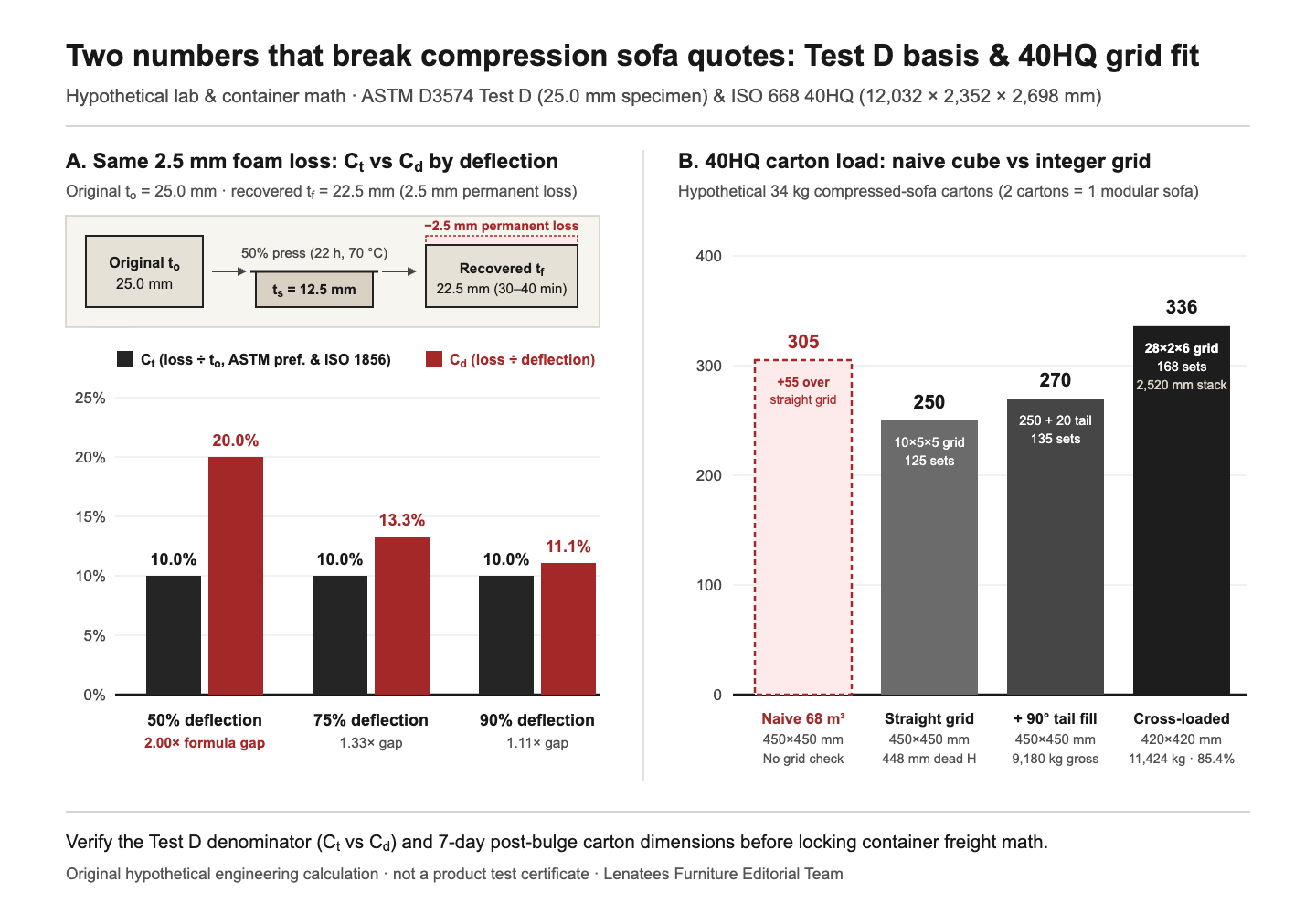
Hypothetical engineering comparison showing how the same 2.5 mm foam thickness loss reports as 10.0% (Ct) vs 20.0% (Cd) at 50% deflection under ASTM D3574 Test D, and how integer-grid 40HQ carton loading drops 55 cartons below naive 68 m³ cubic division before cross-loading and a 30 mm box adjustment recover capacity.
Three physical freight rules belong in every container and last-mile model:
- Carton bulge and handling clearance. Compressed foam presses outward against inner film and corrugated walls. A carton nominally printed at
450 mmcan bow to460 to 465 mmonce stacked five high. In Carton A’s straight grid (5 × 450 = 2,250 mminside2,352 mmwidth), only102 mmremains across five columns (20 mmper box), leaving tight tolerance if boxes swell. Always measure packed outer dimensions (including tape bulge and strapping) on a 7-day-old sample carton before locking a loading diagram. - Ocean payload versus U.S. highway drayage weight caps. Under ISO 668, base
1AAAmaximum gross mass is30,480 kg(roughly26,580 kgnet payload after~3,900 kgtare, or~28,600 kgon modern32,500 kgheavy-rated carrier fleets). Once containers move inland by truck in the United States, however, federal Interstate Highway gross vehicle weight is capped at80,000 lb(36,287 kg) under 23 CFR 658.17 (see also FHWA Federal Size and Weight Regulations). Subtracting tractor, tandem chassis, and container tare typically caps legal highway cargo near19,500 to 20,000 kgwithout tri-axle chassis or overweight permits. All-foam compressed sofas (150 to 180 kg/m³packed density) remain cube-limited far below that threshold (11,424 kgin Carton B above), whereas heavy hybrid spring or steel-mechanism models need early drayage weight verification. - Last-mile U.S. parcel carrier thresholds. Standard UPS Ground and FedEx Ground networks cap individual parcels at
165 inlength-plus-girth (L + 2W + 2H),108 inlongest side, and150 lbactual weight. Exceeding130 inlength-plus-girth (or96 inlongest side) triggers Large Package or Oversize fees; exceeding105 inlength-plus-girth,48 inlongest side,30 insecond-longest side, or50 lbtriggers Additional Handling surcharges; and parcels over70 lb(31.5 kg) require heavy-package warning labels. Because carriers round each dimension up to the next whole inch before dividing (L × W × H) by the standard139retail DIM divisor, shaving30 mmoff Carton A’s cross-section cuts carrier-rounded DIM weight from103 lb(98 lbexact) down to92 lb(86 lbexact) per box while adding66extra boxes (33full two-carton sofas) per 40HQ container. For customs paperwork, fumigation, and port handoff steps out of Guangdong, pair this loading check with our shipping furniture from Foshan to the USA guide.
Pre-order RFQ and incoming QC checklist
Before approving a pre-production sample or releasing a container deposit to any compressed sofa manufacturer, lock eight written checkpoints into your purchase contract:
- Foam specification sheet and lab report: Named test standard (
ASTM D3574-25orISO 1856:2018/ISO 2439:2008/ISO 3385:2014), apparent density, filler disclosure, IFD/hardness load level, dry Test D deflection percentage (50%,75%, or90%) with explicitCtorCdformula, wet heat aging (Test L) where shipments cross humid ocean lanes, and dynamic pounding fatigue (Test I3/ISO 3385) for rentals or hospitality. - Pre-compression curing and hybrid spring protocol: Minimum ventilation hours between foam pouring, adhesive lamination, and vacuum pressing, plus wire gauge, pocket-fabric GSM, and flat-press vs roll-pack confirmation for any hybrid spring-foam module.
- Barrier film and export carton strength: Multi-layer PA/PE film thickness (microns), double heat-seal width, inner slip protection, and corrugated carton edge-crush (
ECT) or bursting rating suitable for 5-to-6-layer ocean stacking. - Sealed storage life and batch dating: Maximum recommended months in vacuum seal, printed packing date on outer cartons, container desiccant plan, and an agreed sample aging hold (keeping one packed unit sealed for 14 to 30 days before opening).
- Timed decompression acceptance tolerances: Written pass/fail tolerances for seat height, overall width, backrest height, corner squareness, and crease recovery measured at 2 hours, 72 hours, and 7 days at room temperature (
20 to 23 °C). - Upholstery recovery and floor grip: Fabric composition, abrasion test method, pile recovery check after unsealing, and non-slip base backing specification so legless modules stay put on tile or wood flooring.
- Market safety and fire compliance labels: Permanent
16 CFR Part 1640/ TB 117-2013 flammability statement for U.S. residential shipments (plusASTM E1537,BS 5852, orBS 7176where commercial project codes require it), along with country-of-origin and law labels positioned to survive vacuum folding. - Post-bulge carton dimensions and loading drawing: Measured 7-day post-bulge
L × W × Hin millimetres and inches, gross weight per carton, U.S. parcelL + 2W + 2Hand DIM-weight check (if shipping DTC), and an explicit 40HQ orientation map clearing the2,585 mmrear door header.
When comparing vacuum-packed frameless models against knock-down or rigid-frame custom sofas for a retail line or multi-family project, share your destination fire rules, expected warehouse dwell window, parcel or container target, and room dimensions with our custom sofa manufacturing team in China or review our compression sofa program overview to confirm current production options before sampling.
Prepared by the Lenatees Furniture Editorial Team with AI-assisted research, drafting, and multi-pass technical verification. ASTM, ISO, U.S. eCFR, and FHWA standards are cited for their published test procedures and regulatory thresholds; the Test D comparison, 40HQ loading grid, and parcel DIM calculations are hypothetical engineering examples, not product test certificates or guaranteed SKU container counts.