




Sofa planning · Bespoke furniture
Sofa Seat Depth: How to Measure and Specify Bespoke Sofa Designs
Measure the usable seat depth with the back cushions in position, then check the result with the people who will use the sofa. Overall sofa depth tells you whether the furniture fits the room; usable depth helps you compare how it feels to sit on. Seat height, cushion compression, back support and posture also matter.
This guide helps homeowners, interior designers and furniture buyers turn a comfort preference into a clear bespoke sofa brief. It separates published dimensional requirements from illustrative sizing ideas, so a reference image or a general height chart does not become an untested order specification.
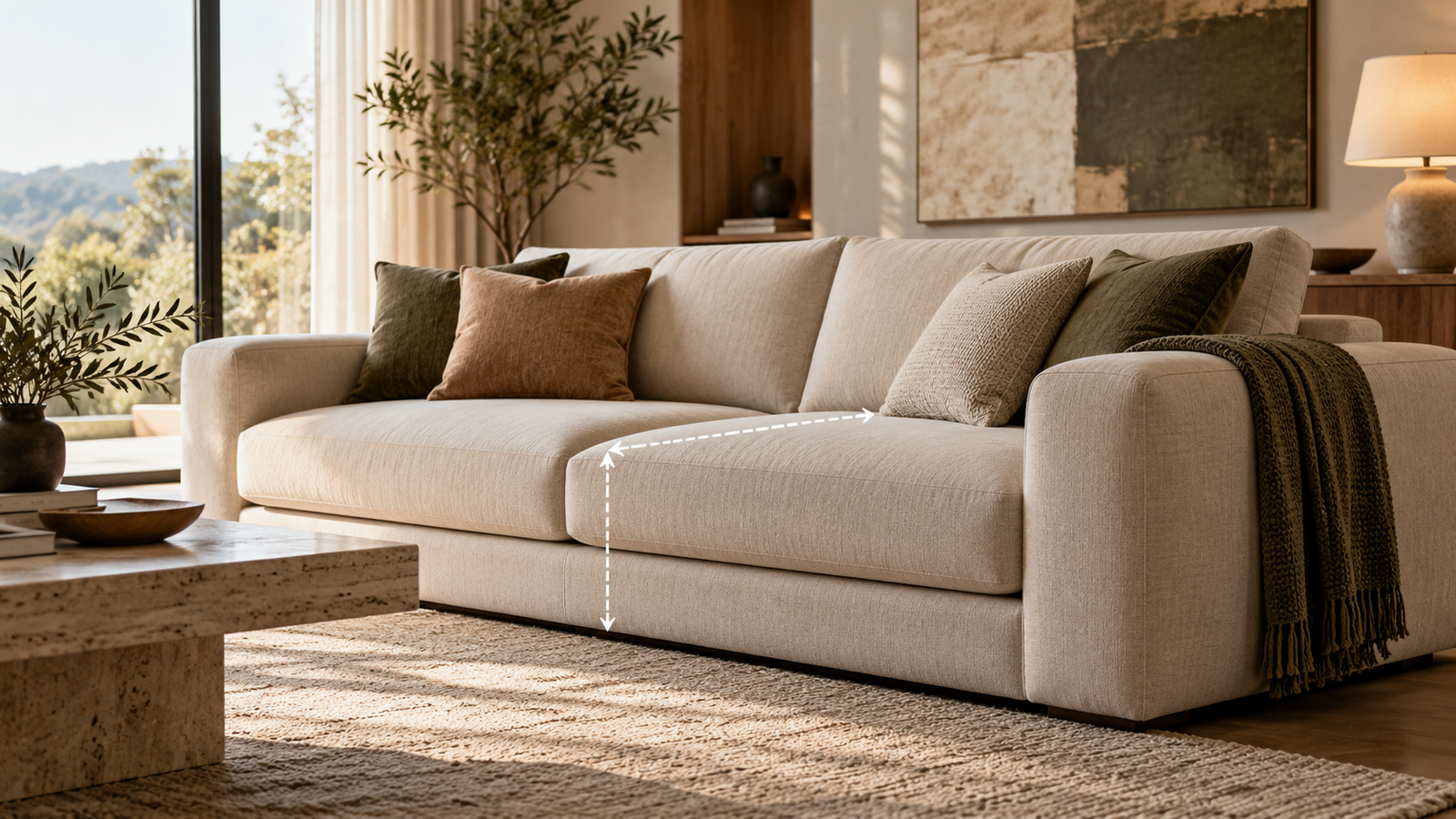
1. Effective seat depth: measure the sitting area
A sofa can look proportionate in a room and still feel too deep or too shallow for a particular person. Measuring from the front of the frame to its outer rear edge will not tell you how much usable sitting space remains in front of the back cushions. Keep the overall footprint and the usable seating dimensions separate on the drawing.
GB/T 39223.6—2020, Ergonomic requirements for healthy home — Part 6: Sofa, clause 3.4, defines seat depth from the centre of the seat’s front edge to the vertical plane through the foremost point of the lumbar-support surface. That gives buyer and supplier a common reference for the measurement.
Clause 4.1.2 of that standard specifies 480–580 mm, approximately 18.9–22.8 inches, for seat depth within its scope. This is a requirement in a particular Chinese standard, not proof that every sofa in that range fits every adult, or that a made-to-measure sofa is certified. Ask which standard and test method apply to the actual product and market.
Do not assume that retail sofas all use a 550 mm depth. Compare the selected models’ labelled drawings and cushions. Two products with the same outside depth may offer quite different usable seating space.
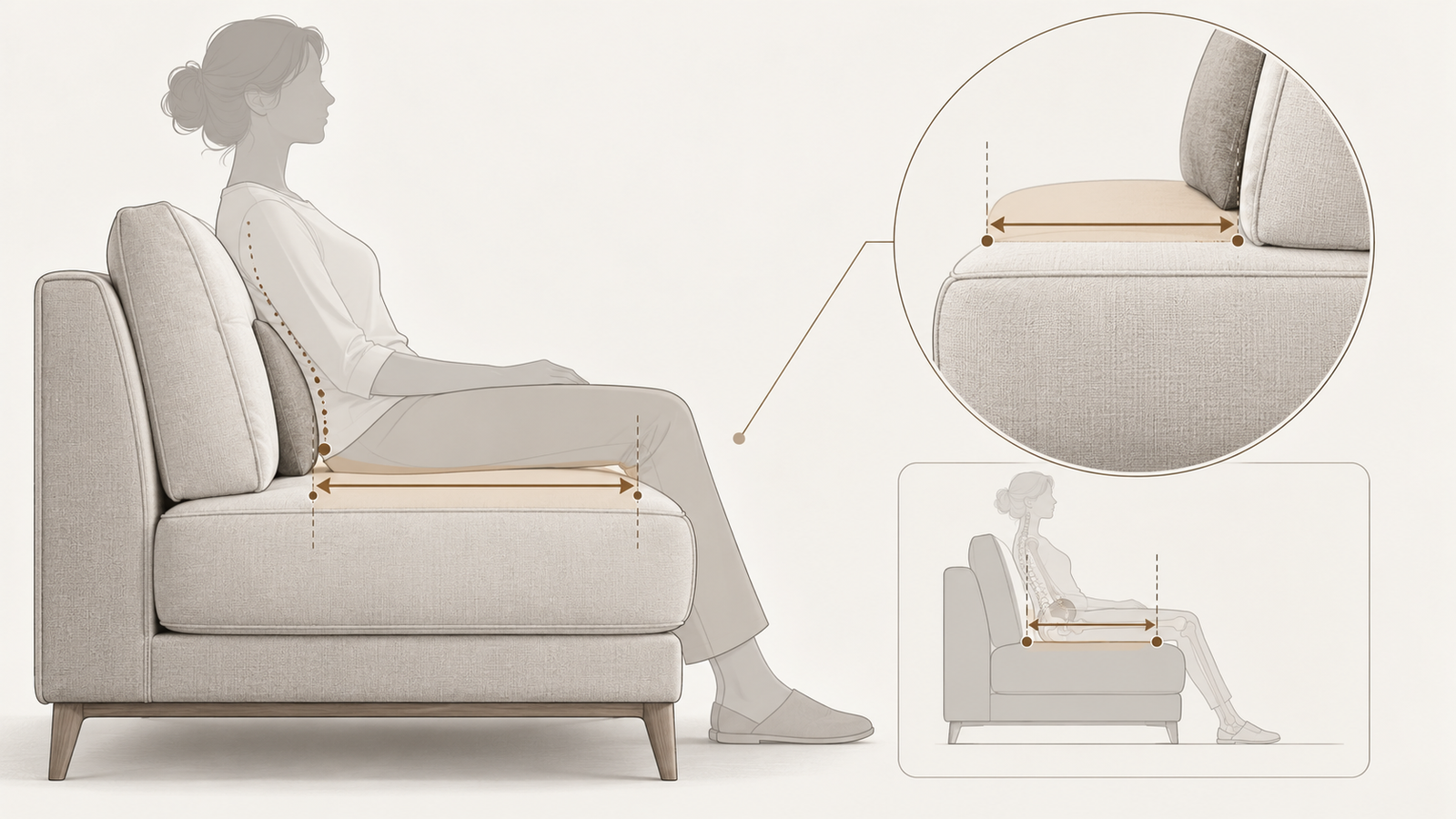
2. A repeatable measurement workflow
For an initial buyer brief, use the same cushion arrangement and measurement points each time. A tape measurement is useful for comparing sofas and discussing a design; it does not replace the full measurement and loading procedure required for a formal conformity assessment.
- Set up the normal seating arrangement. Put back cushions and any lumbar insert in their intended daily positions. Record whether the seat is occupied or unoccupied, and avoid mixing readings taken under different conditions.
- Mark the two reference points. Identify the centre of the front seat edge and the foremost usable back-support plane. Take the depth horizontally rather than following the curved upholstery surface.
- Record the configuration. Note the model or module, cushion arrangement and units. Millimetres are convenient for the manufacturing drawing. If you also use inches, identify which unit controls the order when rounding differs.
- Repeat and photograph. Take a second reading and a clear side-view photograph. For a curved or modular sofa, record any seat positions that differ instead of treating one dimension as valid for every module.
- Check the seat in use. Try the intended reading, conversation or lounging position. Record whether the back is supported, the feet can rest as intended and the front edge feels clear of the backs of the knees.
A firm ruler or straight tape can help you maintain the horizontal measurement. Do not remove a back cushion to obtain a larger number unless the sofa is intended to be used that way. The change in usable depth depends on that cushion’s shape, thickness and compression; there is no universal adjustment to add or subtract.
When no sofa is available, a person’s buttock-to-popliteal (back-of-knee) measurement can help discuss proportions, but it is not automatically the correct seat depth. General OSHA seated-workstation guidance recommends support without pressure behind the knees. That is a useful trial-fit consideration, not a residential sofa sizing formula.
3. Height and lifestyle: use a trial, not a formula
Height alone does not determine the right sofa seat depth. People of similar height can have different leg proportions, and the same person may want different support when reading upright and when stretching out. Use height to help choose what to try, then assess the complete seat.
The metric ranges below are illustrative configurations to compare, not results of a verified height-based study or requirements from GB/T 39223.6. Some lounging examples exceed that standard’s 580 mm seat-depth limit and must not be described as meeting that clause. Do not use this table as an automatic production specification.
| User-height grouping | Upright trial example | Lounging trial example | What to check in person |
|---|---|---|---|
| Under 160 cm | 480–520 mm | 520–580 mm | Can the user reach the back support while keeping the feet supported in the intended posture? Check the seat height as well as its depth. |
| 160–175 cm | 520–560 mm | 580–620 mm | Compare reading and relaxed sitting with the same back cushions. Do not choose the deeper option solely because it looks more generous. |
| Above 175 cm | 560–580 mm | 620–680 mm | Check thigh support and clearance behind the knees. Confirm that other household members can also use the arrangement comfortably. |
For a shared living room, test more than one user. A removable support cushion, a different module or a separate chair may accommodate different preferences more effectively than making every seat deeper. Confirm which changes are feasible for the chosen design.
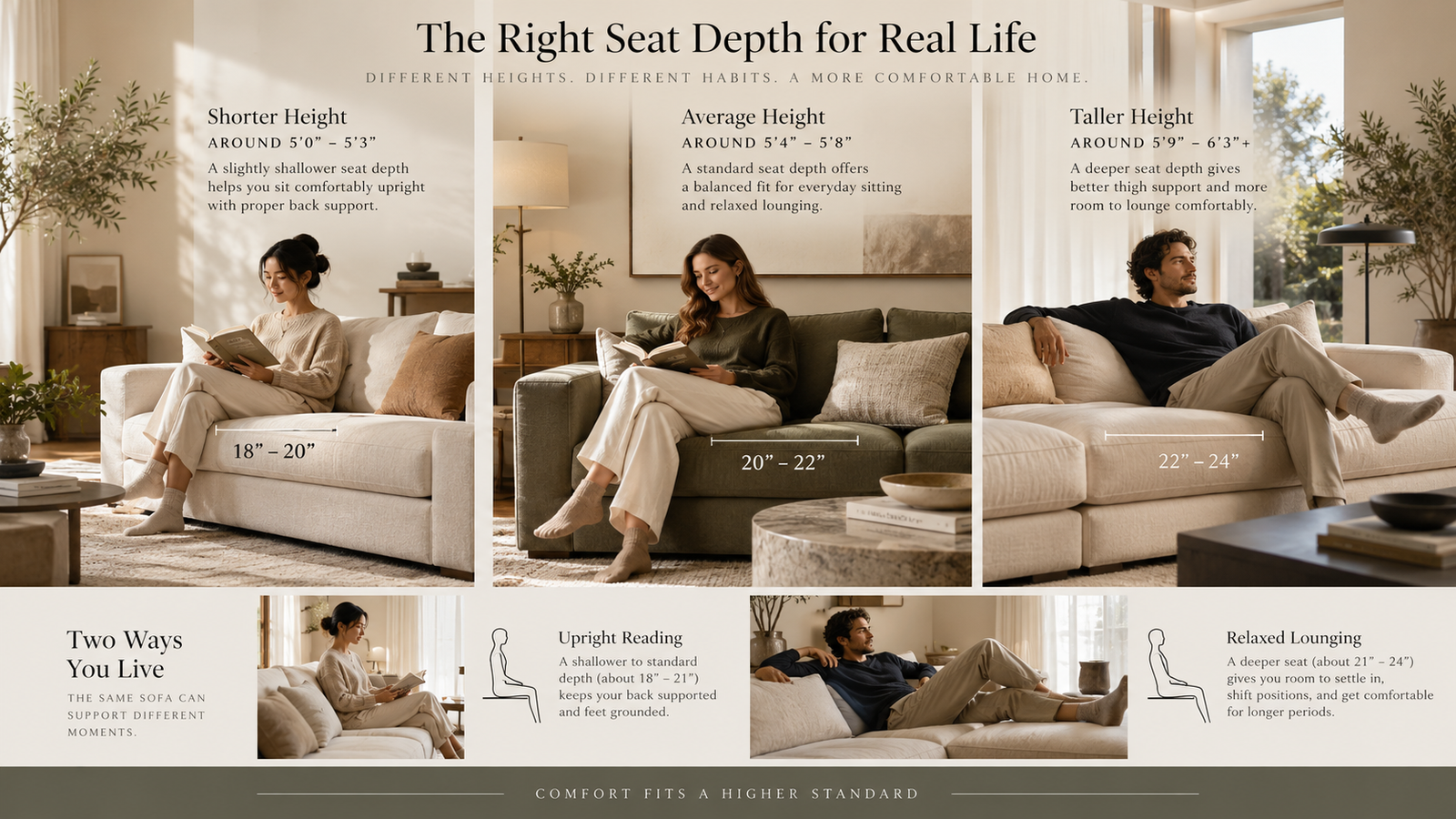
4. Practical sizing rules and trade-offs
Discuss seat depth together with seat height, backrest geometry and cushion behaviour. A deeper seat with a thick, movable back cushion is a different arrangement from the same nominal depth with a slim fixed back. Likewise, a soft cushion can change the seated position as it compresses.
For reference, GB/T 39223.6—2020 clause 4.1.3 specifies a 370–440 mm seat height under the stated 50th-percentile male body-weight load. Clause 4.1.7 specifies a 100°–120° back angle, using the standard’s definition of the angle between the back-front surface and the seat reference plane. These values require their specified definitions and conditions; an unloaded seat-height reading or a backrest angle measured using a different reference or angle convention is not interchangeable.
- For upright use: check whether the user can sit against the back support without moving forward to reach the floor. A shallower usable depth may be worth comparing, but the height and cushions still need a trial.
- For lounging: decide whether the extra space comes from a deeper standard seat, a chaise or an ottoman. These serve different positions and should have separate dimensions on the drawing.
- For getting up: test the complete seat, including cushion compression and arm support. Do not infer ease of standing from depth alone.
- For room planning: check the overall footprint, circulation and delivery access separately. A comfortable seat does not establish that the sofa will fit through the doorway.
There is no evidence here for a universal 680 mm maximum for all residential sofa designs. A very deep lounging configuration should be assessed for its intended use and any applicable product requirements rather than labelled universally suitable or unsuitable. For a compact room, the small-villa sofa layout guide helps separate usable seating from the floor space around it.
5. Turn the preferred depth into a bespoke sofa brief
The practical advantage of a bespoke sofa is the opportunity to discuss dimensions and configuration before production. It does not automatically make a design more comfortable than a ready-made model. The selected construction must be feasible, the requirements must be clear and the sample must suit the intended users.
Send the supplier a marked drawing and a short description of how the seat will be used. Keep the approved cushion arrangement with the drawing revision so that a later fabric or filling change does not quietly change the sitting experience. Read the sofa foam specification guide when comparing cushion information; density alone is not a complete comfort specification.
- State the intended users and the main use: conversation, reading, lounging or mixed use.
- Show overall width, depth and height separately from usable seat width and depth.
- Identify back cushions, lumbar inserts, seat construction and the agreed measurement conditions.
- Request a drawing revision and sample-review process before approving production.
- Confirm quantities, feasible customization, packing dimensions and delivery access for the actual order.

When discussing a project with a شركة متخصصة في تصنيع الأرائك حسب الطلب في الصين, ask for the proposed configuration’s confirmed dimensions and sample arrangements. A reference image, a general sizing chart or a supplier’s description should not replace that agreement.
Final thoughts
Seat depth is an important part of sofa comfort, but it works together with height, back support, cushions and the way the seat is used. Start with a consistent measurement, compare suitable configurations and record the approved result in the order brief. Keep illustrative preferences separate from formal product requirements and verified specifications.
Standards and measurement references
The references below have different scopes. Mentioning them does not establish that a pictured sofa or Lenatees product has been tested or certified to them.
- GB/T 39223.6—2020 — Ergonomic requirements for healthy home, Part 6: Sofa. Source for the seat-depth definition and the specific dimensional clauses discussed above. The full standard and its assessment conditions remain necessary for a conformity review.
- QB/T 1952.1—2023 — Upholstered furniture, Sofas. A separate sofa industry standard; the height-based planning examples in this article are not presented as its requirements.
- GB/T 38733—2020 — Office furniture, Office chairs, Methods for the determination of dimensions. Its scope is office chairs, so it is not used here as the authority for residential sofa dimension ranges.
- OSHA — Computer Workstations: Chairs. General seated-workstation fit considerations; not a residential sofa specification.
Discuss your sofa dimensions with Lenatees
Share your room plan, preferred sofa reference, intended seating habits, quantities and destination. We can review the requested customization; final dimensions, materials, sample requirements and order terms are confirmed for the selected design.
Prepare a custom sofa brief